Phone Coverage When You Add Providers or Acquire a Practice
New providers and acquisitions change who calls you, about what and on which numbers. How to keep the phones working through the transition.
One Voice runs medical scheduling call centers for hospitals, medical offices, and specialty practices that need appointments booked accurately, calendars kept full, and scheduling pulled off the plates of overloaded front-desk staff.
Our agents schedule, reschedule, confirm, and cancel appointments directly inside your existing EHR/EMR and scheduling tools—following your provider availability, appointment types, and booking rules. The result is faster scheduling, fewer gaps in the calendar, and a patient experience that feels like your own front office.
Booking a medical appointment isn’t just picking a slot—it’s matching the right provider, appointment type, visit length, and prep requirements while respecting insurance and referral rules. Generic call centers get this wrong and create no-shows, double-bookings, and frustrated patients.
Our agents are trained on your scheduling logic: provider preferences, appointment templates, visit types, buffer times, and location-specific rules. Because they work inside your EHR/EMR and scheduling platform, every booking lands in the right place with the right details—no separate system, no manual re-entry.
Every unanswered call is a patient who books elsewhere—or doesn’t book at all. Industry estimates put the cost of a single missed patient call in the hundreds of dollars once you account for the lifetime value of the appointment, follow-ups, and referrals that never happen.
Now multiply that across every call that hits voicemail during lunch, after hours, or when your front desk is helping the patient standing in front of them. A dedicated scheduling team captures that demand instead of leaking it—turning calls you’re currently missing into booked, revenue-generating appointments.
See how one health system cut call abandonment from ~40% to under 3% — read the patient access case study →
Front-desk teams juggling walk-ins, check-ins, and ringing phones can’t give scheduling the attention it needs, and empty calendar slots quietly drain revenue.
Patients reach a live, healthcare-trained agent who books the right appointment the first time—matching provider, visit type, and availability inside your system.
We proactively reach patients for follow-ups, annual visits, lapsed care, and recall lists—turning your patient database into a fuller calendar.
When plans change, agents reschedule or cancel cleanly and offer the freed slot to waitlisted patients, protecting your utilization.
Appointment confirmations and reminder calls reduce no-shows and keep providers’ schedules predictable.
We manage waitlists, honor referral and insurance requirements, and route complex scheduling needs according to your escalation rules.
Patients schedule in the language they’re most comfortable with, so language barriers never cost you a booking or a patient.
Insurance issues are easier to resolve when they are identified before the appointment is booked. Our scheduling teams coordinate with insurance verification and prior authorization workflows to surface coverage requirements early, reduce day-of surprises, and help prevent avoidable denials
Explore Related Services
Insurance Benefits Verification →
Prior Authorization Support →
Scheduling rules vary widely by specialty, and our agents are trained on the terminology, visit types, and prep requirements specific to your field, including:
Don’t see your specialty? Our scheduling programs are built around your workflows, whatever the field.
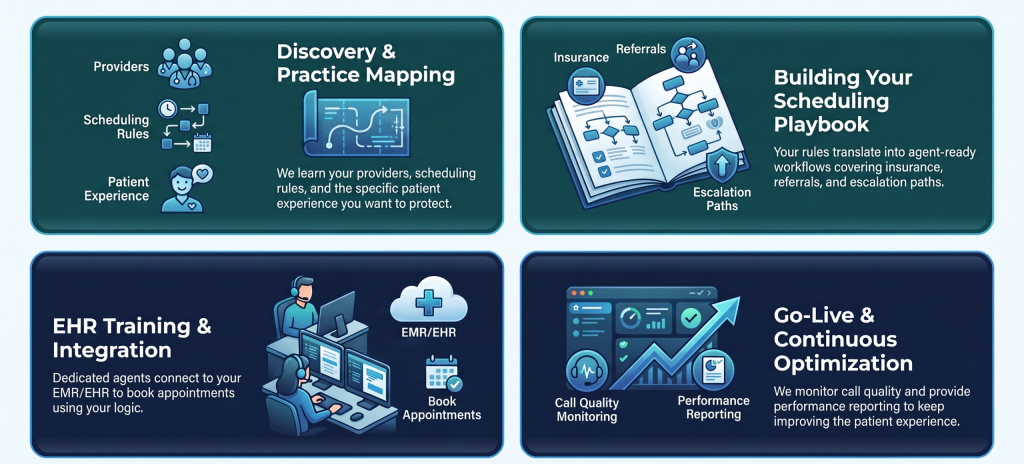
A collaborative, guided four-phase process for seamlessly integrating a professional scheduling service as an extension of your medical practice.
Let’s build a scheduling line that keeps your calendar full and your front desk free. We’ll map your workflows, train a dedicated team on your rules, and have you live in weeks—not months.
Yes. Our agents work inside your existing EHR/EMR and scheduling tools, following your provider availability and booking rules—no platform change required.
Yes. We answer inbound scheduling calls and run outbound recall, follow-up, and reactivation campaigns to keep your calendar full.
Our scheduling teams capture eligibility and authorization requirements at the point of booking and can coordinate with our insurance verification and prior authorization teams to resolve issues if you desire.
Through confirmation and reminder calls, easy rescheduling, and waitlist management that fills openings created by cancellations.
Yes. We offer bilingual and multilingual scheduling so patients can book in their preferred language.
Yes. We maintain strict HIPAA and HITECH compliance, including secure data handling, controlled access, and certified staff.
Most scheduling programs are operational within 4–6 weeks, depending on system integration and the complexity of your booking rules.
Practical guides on scheduling models, reminders and multi-site routing.

New providers and acquisitions change who calls you, about what and on which numbers. How to keep the phones working through the transition.

Text reminders work about as well as calls for routine visits, at lower cost. Where a phone call still earns its place, and how to measure it.

How much front-desk time goes to scheduling and reminder calls? Nobody publishes a reliable number. How to measure yours in a week, and what to do.

When a group has clinics in several cities, calls and new patients land at the wrong site. What causes it, and what to fix first, in order.

Dental front desks lose calls every time the waiting room fills. What to ask a contact center partner about recall, overflow and dental insurance.

Seven scheduling models, and the different job each one hands to whoever answers the phone. The more flexible it looks to patients, the harder it gets.